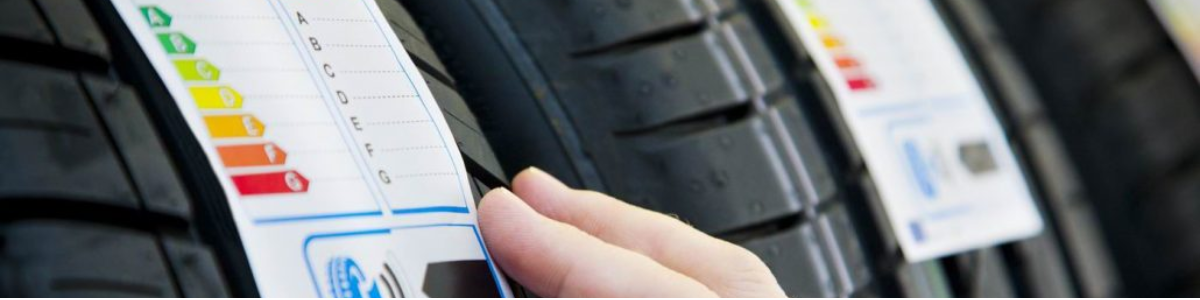
The European Tire Label is a classification system created by UE to offer drivers clear data on tires’ performances.
It is evaluated the fuel consumption, the braking capability on wet floors and the levels of external noise.
Efficiency classes go from A (maximum) to G (minimum), offering to consumers a clear parameter to choose the safest and greenest tires.
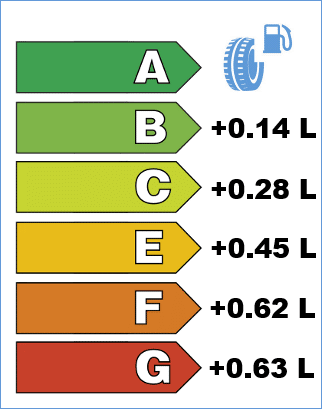
Introduced in November 2012, the EU Label was created to satisfy the rising demand for transparency and safety in the automotive sector.
After years of testing, EU established even parameters to allow customers to make informed choices and to promote using tires with fewer CO2 emissions and better energetic efficiency.
This system marked a revolution in the market, incentivizing the companies to develop tires with better performances.
What checks are carried out to obtain the European Label?
To get the EU label, tires must pass stringent tests that measure actual performance.
The rolling resistance coefficient, wet braking capacity and external noise are evaluated.
Companies are obliged to meet high standards, ensuring that tyres on the European market meet the most stringent safety and sustainability requirements.
In addition to the mandatory tests, manufacturers must regularly submit their tyres to independent checks by certified bodies. These tests are performed in specialised laboratories and under varying conditions, such as extreme temperatures or particularly slippery surfaces, to ensure that the declared performance is reliable in any driving situation.
The control bodies also carry out spot checks on products sold, to ensure that performance does not drop over time.
The European label is an initiative of the European Union, which has set high standards for safety and sustainability.
The aim is to improve vehicle efficiency and reduce environmental impact.
Outside Europe, there are different systems like the DOT in the US, but they do not provide the same detailed information.
In summary, the EU label remains exclusive to the EU market, promoting safer and more eco-friendly tyres.
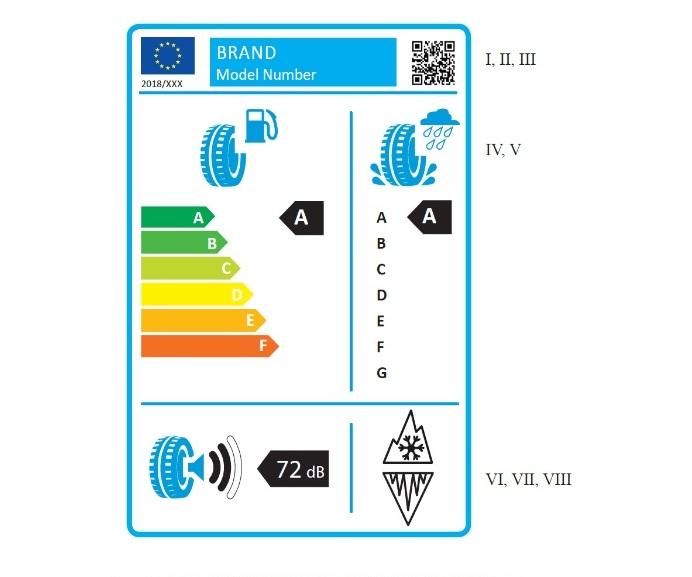
The European label and the DOT (Department of Transportation) are two separate rating systems.
While the EU label focuses on energy efficiency, grip and noise, the DOT label is more focused on legal compliance and the tyre’s production date.
The DOT provides information on rubber manufacturing, such as production plant and construction week, without assessing its efficiency or safety.
Therefore, if you want to know the actual performance of a tyre in Europe, you will have to refer exclusively to the European label.
If you are interested in finding out which tyres are the best for reducing fuel consumption, we recommend that you read our article on the best low-consumption tyres of 2024.
In conclusion, the EU tyre label is an essential guide for those who want to buy safer, more efficient and more environmentally friendly tyres.
With this information, you can choose tyres that not only improve the performance of your vehicle but also contribute to a reduction in CO2 emissions and fuel consumption.
For more information on how to choose the ideal tires for your vehicle, contact us via WhatsApp or email.
Click here and find out more on our website and receive personalized assistance to find the tires that best suit your needs!
The Type of the car is a code that the producer assigns to each vehicle in order to distinguish it from similar models.
You can find this code in the italian registration certificate in two places: At point D.2, Vehicle type, or at point E, vehicle identification number.
If you need help, contact us via WhatsApp at 345 0634873